Machine Maintenance (Equip Repair gallery)
Taking care of equipment is crucial, as equipment is hard to come by, very expensive to purchase, and must last for a long time. After having started out with a 1984 diesel tractor, a three-foot pull behind Ryan aerator, a Herd 3pt hitch spreader, and a 50 gallon 3pt hitch sprayer, I understand what it was like to have very little equipment to get by on.
As the years progressed, I began studying equipment and was able to see our first purchase of a 1996 Aeravator AE-60, which I saw put to use at Pike HS in Indy during Floyd Perry's Groundskeepers Management Academy. The machine was utilized both for turf and skinned area maintenance. Since then, I have steadily worked to build a complete turf program with all needed equipment at an advanced level via research and written reports.
For equipment to be taken care of, I researched grounds building formats with the help of Jim Lemasters, a former teacher now retired, who spent his summers working grounds maintenance in the town where he lives. The grounds building we now have has radiant in-floor heat, several work bays, and a wash bay with pressure washer and cleanable drain.
In keeping equipment fit for inspection and maintenance, we must keep this equipment clean, and have a lift in the wash bay to access the underneath areas. (see image 1-1)
Sharpening blades is essential to the proper grooming of turfgrass, and so a blade sharpener and balancer are required in the shop. (see image 1-2)
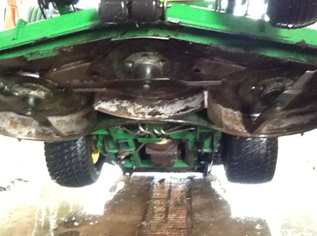
image 1-1
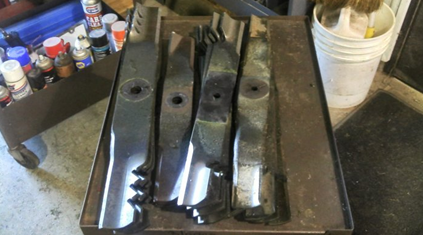
image 1-2
In support of working on equipment, we must have the proper tools, and preferably favorable to six-sigma. (see image 1-3)
Machines require proper lubrication. (see image 1-4)
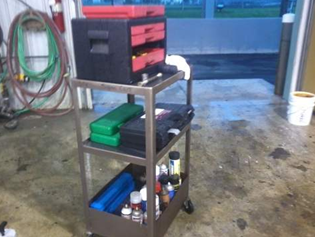
image 1-3
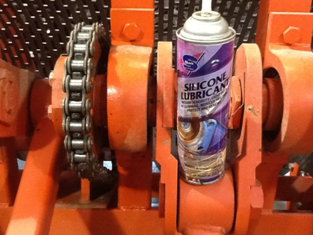
image 1-4
Sometimes threads must be chased, along with the appropriate lubrication and new bolts after threads stretch. (see image 1-5)
Also keeping in mind that metal oxidizes and deteriorates, making preventative measures necessary by utilizing a good quality paint that fights against rust and rugged use. (see image 1-6)
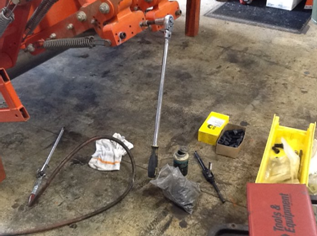
image 1-5
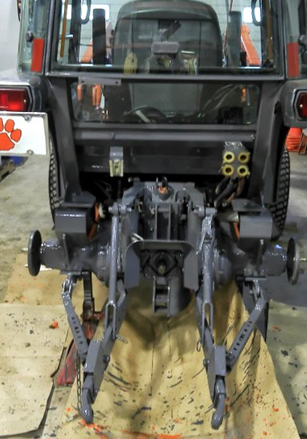
image 1-6
Rust-Oleum brand colored farm paints make an economical choice to protect grounds equipment over long time usage. (see image 1-7)
Oil changes are required to make engines last at acceptable performance levels, including good quality oils and filters kept organized and labeled. (see image 1-8)
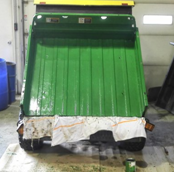
image 1-7
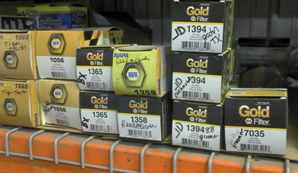
image 1-8
Oil changes need to be logged, so the due time is known by the operator. Writing the hour number when this next service is due on the oil filter is one way of achieving that, although many different ways are utilized, such as paper or computer logs. Advanced formats are computers that read the hours on a machine when it enters the shop and show how many hours remain before the next service is due. (see image 1-9)
Maintenance that can be achieved during the winter in the shop saves on charges paid for this service otherwise done by a contractor. Following this, we see the blades I'm changing on an old 1977 slit seeder. (see image 1-10)
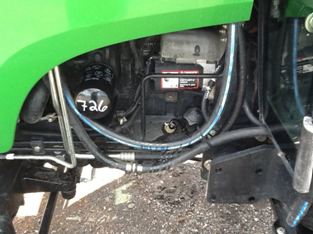
image 1-9
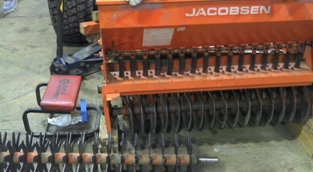
image 1-10
Finally, keeping a shop organized to be able to locate supplies keeps a shop functional. (see image 1-11)
Good machine maintenance is visible to bystanders, and shows if the users are taking care of their equipment, which makes a statement to those who fund the purchase of new equipment. Pride is also added to the users and the organization when equipment purchased 20 years ago, like our Aeravator AE-60, is still in use today.
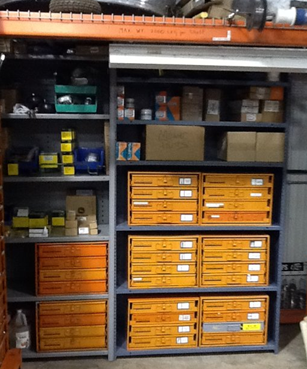
image 1-11